How often should an office be cleaned
There is no single right frequency for office cleaning, but there is a right way to work yours out: some areas need attention daily whatever your size, and everything else scales with headcount and traffic. Here is the schedule that keeps an office presentable without paying for visits it does not need.


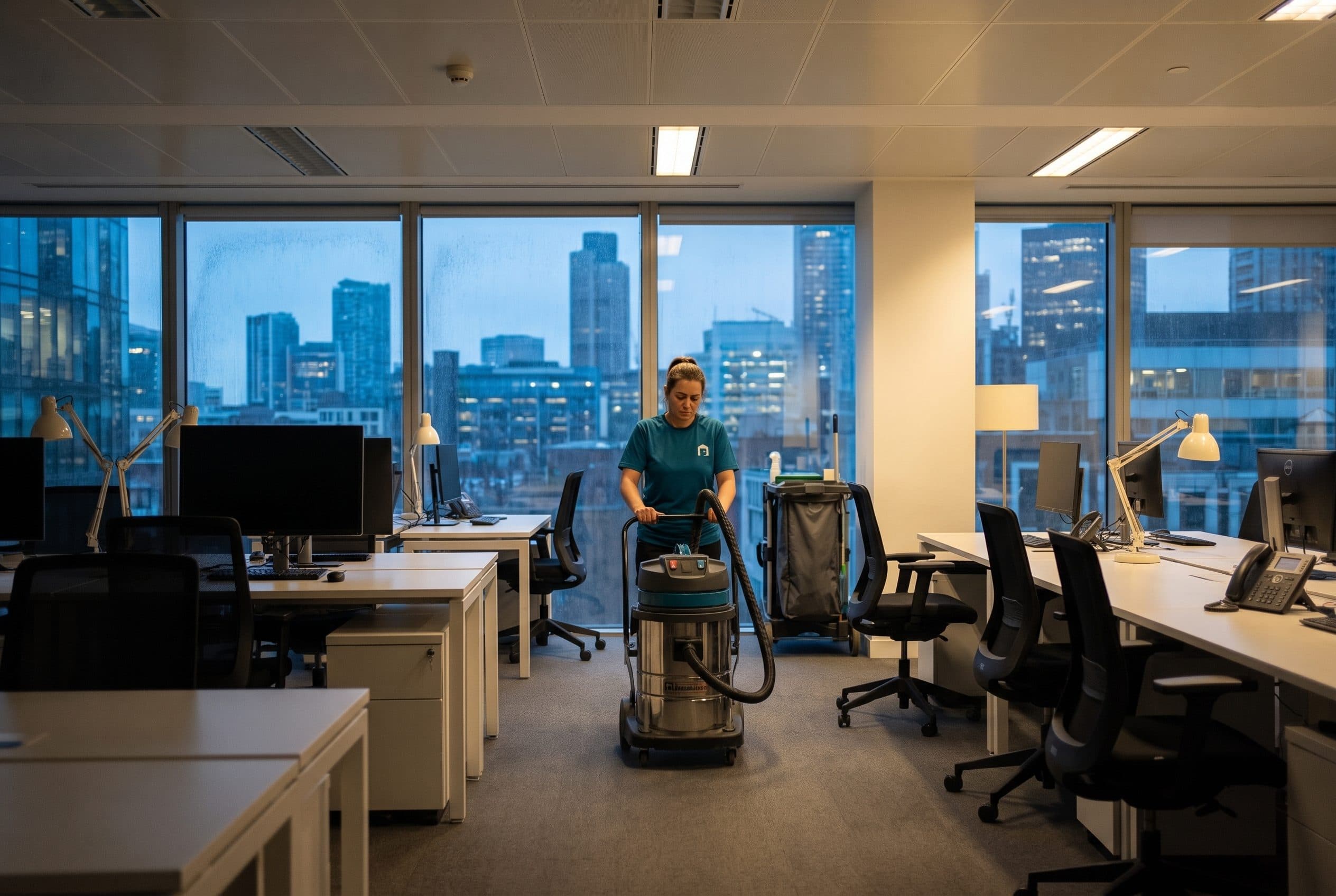
Toilets, kitchens and touchpoints need attention every working day in any office where people are in most days. Beyond that, frequency scales with headcount: a small studio holds its standard on one or two visits a week, a 20-person office usually needs two or three, and offices past roughly 50 staff tend to justify a daily clean. Deep cleans sit on top, once or twice a year, with carpets on their own cycle.
Daily, whatever your size
Hygiene areas do not care how many desks you have. Toilets and kitchens used daily need cleaning daily, and the touchpoints everyone shares, door handles, kettle, fridge, printer, meeting-room tables, are where an office starts to feel neglected first. If the budget only stretches to a few visits a week, spend them here and let the desks wait, not the other way round.
Scaling with headcount
Headcount is the starting point, not the whole answer. A ground-floor office with walk-in visitors, shared meeting rooms in constant use, or staff eating at desks will need more than the row above suggests. A quiet office of hybrid workers in three days a week will need less. Watch the state of the office on the morning before a scheduled visit: that is your evidence, in either direction.
Where deep cleans fit
A regular schedule maintains surfaces in use. It does not reach vents, high dusting, behind furniture, or the build-up in carpet pile, which is what a periodic deep clean is for. Once or twice a year is the usual rhythm, with carpets and upholstery professionally cleaned every three to six months in busier offices. Book deep cleans for quiet periods, and treat one as the reset point whenever a regular schedule has lapsed.
Setting your schedule
Write the schedule down as a specification: which areas daily, which weekly, which monthly, and who supplies consumables. A written schedule is what makes the standard checkable, and it is what lets you change frequency deliberately instead of drifting. Start at the row that matches your headcount, run it for a month, and adjust on what you see.
Tell us the size, the layout and how the space is used. We will recommend a schedule honestly, including where fewer visits would do.
Request a quote